English

 Home
Home Hotels
  Car Rental
 Rewards
 Travel Guide
A Little More Time in Gatlinburg Goes a Long Way

Gatlinburg is easy to underestimate when a trip is measured in hours. A traveler arrives, walks the Parkway, eats something good, rides to a viewpoint, and suddenly the day is nearly gone. What usually gets missed is not another attraction with a ticket window. It is the space between those attractions: the river running beside town, the forest beginning just beyond the last storefronts, a road curling past an old cabin, or enough time to sit on a bench without checking what comes next.
That is why adding even part of another day can change a Gatlinburg itinerary more than expected. Great Smoky Mountains National Park begins directly beside town, and its Sugarlands area, short trails, historic roads, and higher mountain routes are close enough that visitors do not need to choose between “seeing Gatlinburg” and “seeing the Smokies.” With more breathing room, both start to fit together naturally.
The difference is mostly pace. Instead of squeezing a forest walk between breakfast and a reservation, a visitor can let the trail run long. Instead of driving straight to the highest viewpoint, there is time to stop where Newfound Gap Road opens onto another layer of blue ridges. The Arts and Crafts Community becomes a place to browse rather than a rushed detour.
A longer stay does not need a longer checklist. In Gatlinburg, a little more time works best when it creates fewer deadlines.

Start the Second Morning Without Trying to Beat the Clock
The first morning in Gatlinburg often carries a little urgency. Visitors want breakfast, parking, directions, and a first look at the town before they feel they have truly arrived. A second morning is different. There is already a sense of direction, which means the day can begin more simply.
This is a good time to walk instead of immediately getting into the car. River Road and the quieter edges of downtown offer a softer start than the busiest stretch of the Parkway. The West Prong of the Little Pigeon River runs close enough to town that a visitor can hear water moving over rocks while storefronts sit only a short distance away. That contrast is one of Gatlinburg’s best features, and it is easiest to appreciate before the sidewalks get crowded.
A slower morning also makes a proper breakfast feel like part of the trip rather than fuel between stops. There is no need to rush through coffee because an attraction opens at a certain minute.
For travelers continuing toward the national park, this is also the time to sort out practical details. Great Smoky Mountains National Park still has no entrance fee, but vehicles parked for longer than 15 minutes require a physical parking tag. Buying a tag does not reserve a space, so arriving earlier at popular areas remains useful.
The goal is not to start earlier for the sake of being efficient. It is to begin the day without immediately feeling behind.

Give the Gatlinburg Trail More Than a Quick Walk
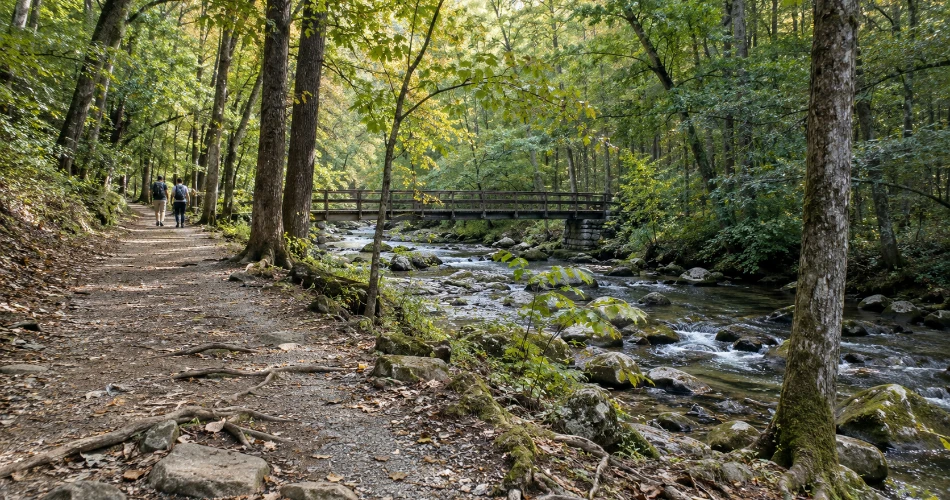
The Gatlinburg Trail is exactly the kind of place that improves when the schedule loosens. It runs about two miles one way between Gatlinburg and Sugarlands, following a mostly broad route through forest and alongside the river. Sections include paved road, crushed stone, roots, and uneven dirt, with a few steeper areas, but much of the trail is relatively gentle. It is also one of only two trails in Great Smoky Mountains National Park where pets are permitted.
On a short trip, visitors often walk to the pedestrian bridge, take a few photographs, and turn back. With more time, the trail becomes less about reaching a landmark and more about noticing how quickly downtown disappears. The traffic noise drops away, mature hardwoods close over the path, and the river keeps appearing through the trees.
Historic stone chimneys and traces of earlier settlement add another layer to the walk. Nothing here demands a dramatic hiking effort, which is part of the appeal.
Travelers wanting an even easier alternative can use the nearby Sugarlands Valley Nature Trail. The National Park Service describes it as a fully paved, flat half-mile loop, making it one of the more accessible short walks around Sugarlands.
A little extra time allows both kinds of walking to feel worthwhile instead of secondary.
Roaring Fork Is Better When Nobody Is Watching the Clock
The Roaring Fork Motor Nature Trail looks short on a map, which is exactly why rushed visitors misjudge it. The scenic route is meant to be driven slowly, with historic home sites, streams, forest, and hiking access breaking up the road along the way. The National Park Service suggests roughly an hour just for touring the area, with additional time needed for historic structures or hikes.
That extra time changes the experience. Instead of watching the road only for the next stop, travelers can pull over where permitted, walk around an old homestead, and imagine what year-round life in such a narrow mountain valley would have been like. The forest sits close to the road, and water accompanies much of the drive.
Near the end, Place of a Thousand Drips is one of the route’s best-known roadside features. After wet weather, water spreads across the rock face in thin streams and trickles rather than forming one tidy waterfall. The effect can be subtle in dry periods and much more active after rain.
The road also provides access to the Trillium Gap Trail toward Grotto Falls, although trailhead parking can become difficult at busy times.
This is where a longer Gatlinburg itinerary pays off. Roaring Fork does not need to compete with three afternoon attractions. It can simply take as long as it takes.

Let the Craft Loop Fill an Afternoon Instead of Twenty Minutes
The Gatlinburg Arts and Crafts Community is another place that suffers when treated as a quick stop. The district follows an eight-mile loop around the Glades area and has roots dating to 1937, when local craftspeople began establishing studios outside central Gatlinburg. Today, the loop includes more than 100 artists, craftspeople, shops, studios, and galleries.
A traveler with limited time may drive through, step into one pottery shop, and decide the idea has been covered. Another hour or two changes that entirely. Different studios focus on pottery, woodcarving, paintings, textiles, leatherwork, jewelry, baskets, candles, musical instruments, and other handmade work. Some spaces are polished galleries; others make it obvious that work is actually being produced there.
The best way to spend time here is not to attempt every stop. Choosing a few studios based on genuine interest makes the loop more personal.
A simple plan works well:
- stop where the craft itself is interesting, not just where parking is easiest;
- watch a demonstration when one happens naturally;
- leave room for conversation instead of treating every studio like a retail transaction.
That slower approach also gives the area historical context. Gatlinburg has a long relationship with Appalachian craft traditions, and the Glades district makes that history feel more lived-in than displayed.

Take Newfound Gap Road as a Drive, Not Just a Way to Reach Kuwohi
Travelers with limited time tend to treat Newfound Gap Road as transportation. The goal becomes reaching the state-line overlook or continuing to Kuwohi, while everything between Sugarlands and the destination turns into scenery through a windshield.
With a little more time, the road itself becomes one of the best parts of the day. As it climbs from the Gatlinburg side of Great Smoky Mountains National Park, the surrounding forest changes with elevation. The National Park Service compares the ecological transition to driving from Georgia to Maine because several forest communities appear over a relatively short mountain climb.
Pullouts make it easy to stop when the view suddenly opens. Some overlook deep valleys; others reveal long walls of forested ridges fading gradually into blue. Conditions can also change noticeably during the climb. A warm, clear morning in Gatlinburg can become cooler, windier, or cloudier at higher elevations.
The useful rule is to avoid stopping at every overlook simply because one exists. Choose a few that genuinely offer a different perspective and give them ten minutes rather than giving ten overlooks one minute each.
Visitors should also check park road conditions before starting. Mountain weather can temporarily affect high-elevation access even when conditions in town seem harmless.

Save Kuwohi for When the Clouds Give Something Back
Kuwohi is the highest point in Tennessee, and its observation tower provides a 360-degree view over the valleys and ridges of the Great Smoky Mountains. Reaching the tower requires a short but steep paved walk from the parking area, with benches along the route for visitors who want to break up the climb.
The mistake is assuming that because Kuwohi is famous, it should automatically be visited at whatever time the itinerary allows. The summit is high enough that weather becomes part of the experience. Clouds can erase the distant ridges completely, and visibility can change surprisingly quickly.
An extra half-day creates the flexibility to watch conditions. If the summit is buried in cloud in the morning, another activity can come first. If the afternoon clears, Kuwohi suddenly becomes worth the drive.
That flexibility matters more than squeezing in one additional attraction downtown.
When conditions cooperate, the view is less about identifying individual peaks and more about understanding the scale of the Smokies. Ridges stack one behind another, forest covers almost everything visible, and the built-up world around Gatlinburg feels much farther away than it really is.
The climb can feel steeper than its distance suggests, so good walking shoes, water, and a pace that allows for stops make the visit more enjoyable.

Use the Extra Hours for the Things That Cannot Be Scheduled Well
Some of the best Gatlinburg moments are awkward additions to a tightly planned trip. Sitting beside a stream does not have an obvious start time. Neither does stopping at an overlook because the light suddenly improves. A craft demonstration may begin just as somebody is preparing to leave. A quiet section of trail may make a traveler decide that lunch can wait another twenty minutes.
Those are exactly the experiences that additional time protects.
A good longer Gatlinburg itinerary should therefore contain deliberate empty space. That does not mean wandering without any plan. It means building the day around two or three priorities and allowing everything between them to remain flexible.
For example, a relaxed day might include the Gatlinburg Trail in the morning, the Arts and Crafts Community after lunch, and a drive on Roaring Fork later. Another might stay almost entirely inside Great Smoky Mountains National Park, combining Sugarlands, Newfound Gap Road, and Kuwohi.
The park’s own planning information reinforces the value of flexibility. Parking tags are required for vehicles parked longer than 15 minutes, but they do not guarantee a parking space at a specific trailhead or overlook.
That makes backup options useful rather than pessimistic. If one parking area is full, the day does not need to become a waiting exercise. Another road, trail, or viewpoint is usually close enough to take its place.

The Extra Hours Are Usually the Ones People Remember
A little more time in Gatlinburg does not necessarily produce a longer list of places visited. Often it does the opposite. It allows visitors to stop counting.
That matters because Gatlinburg works unusually well as a place where different kinds of travel sit close together. Downtown can be lively and crowded, yet the Gatlinburg Trail reaches into the national park from the edge of town. The Roaring Fork Motor Nature Trail starts close enough to central Gatlinburg that a busy street can turn into shaded forest remarkably quickly. The craft loop adds another side of local life, while Newfound Gap Road and Kuwohi pull the day toward higher elevations and much larger views.
None of those experiences benefits from being rushed.
For first-time visitors, another half-day or full day makes the destination easier to understand. For returning travelers, it creates the chance to spend longer in places that were previously treated as side trips. Either way, the extra time becomes less about seeing more and more about seeing properly.
The trip may ultimately be remembered for something modest: mist lifting from the mountains, the sound of the river beside a trail, a potter shaping clay, or an unexpected ten minutes at an empty overlook.
Gatlinburg has plenty to fill a schedule. Its real advantage is what happens when the schedule finally leaves a little room.
Next post The Gatlinburg Places That Make You Want to Stay Longer
Previous Post Gatlinburg Beyond the Parkway: Where the Day Can Take You
About Author