English

 Home
Home Hotels
  Car Rental
 Rewards
 Travel Guide
Gatlinburg Sights Worth Making Time For

Gatlinburg can be a slightly deceptive place on a first visit. The downtown streets pack attractions, restaurants, shops, overlooks, and mountain rides into a remarkably small area, while one of America's most visited national parks begins almost immediately beyond town. That makes it tempting to keep moving simply because something else is always visible around the next corner. A better Gatlinburg sightseeing plan gives the strongest places enough time to make an impression. Some of the best Gatlinburg sights provide sweeping views over the city; others lead straight into cold mountain streams, hardwood forest, high-elevation spruce-fir country, or workshops where local crafts are still made by hand. The following stops are not simply places to photograph and leave. They work best when visitors slow down, allow for changing mountain weather, and build the day around a few worthwhile experiences rather than attempting to collect every attraction on the Parkway.

Make Time for the View at Gatlinburg SkyPark
Gatlinburg SkyPark earns its place on a list of worthwhile Gatlinburg sights because the mountain setting is the attraction, not merely a backdrop. Visitors ride the SkyLift from the Parkway to the mountaintop, where downtown Gatlinburg suddenly looks much smaller and the wooded ridges beyond it become the real focus. The best-known feature is the SkyBridge, which stretches almost 700 feet across the valley. A 30-foot glass section sits near the middle, while the bridge reaches roughly 500 feet above Gatlinburg at its highest point.
The crossing does not need to be treated as a race. Pausing at the overlooks and spending time on the SkyTrail often makes the visit more satisfying than immediately heading back downhill. Clear late-afternoon weather is particularly rewarding because the folds in the mountains become easier to distinguish as the sun drops.
Crowds can be heavier during summer weekends and October foliage season, so travelers mainly interested in photography and scenery usually benefit from arriving outside the busiest middle part of the day. Mountain visibility can change surprisingly quickly; a cloudy morning does not always mean the view will stay hidden.

Give Anakeesta More Than a Quick Ride Up the Mountain
Anakeesta is easy to underestimate when viewed from the Parkway. The ride uphill is only the beginning; the mountaintop attraction spreads across more than 90 acres and combines gardens, overlooks, elevated walkways, family activities, and forest scenery. Among its strongest sightseeing features is AnaVista Tower, reached by 86 steps and offering a 360-degree panorama with markers identifying surrounding peaks. The Treetop Skywalk now extends for more than 1,000 feet across 16 hanging bridges suspended among the trees.
Those features make Anakeesta better suited to a half-day than a hurried hour. Travelers mainly interested in scenery can spend time around Vista Gardens, AnaVista Tower, the overlooks, and the elevated forest walk without filling the visit with every optional activity.
The attraction also changed considerably during its ongoing expansion. By 2026, the Crystal Express lift, reworked Firefly Village, an enhanced Treetop Skywalk, and a new nighttime firefly-themed experience had opened as part of a multi-year project. That is useful context for returning visitors whose last trip may have looked quite different.
For mountain views, late afternoon provides softer light, while staying into the evening changes the atmosphere completely as Gatlinburg begins lighting up below.

Start the National Park Portion of the Trip at Sugarlands
Only about two miles south of Gatlinburg, Sugarlands is where the town gives way to the Great Smoky Mountains almost immediately. Sugarlands Visitor Center is a particularly useful first stop for travelers who want more than roadside scenery. Rangers, natural-history exhibits, park maps, restrooms, and current trail information are available here, and the surrounding area offers several short ways to get into the forest without committing to a long hike.
One of the easiest is Cataract Falls. The walk begins behind the visitor center and covers about 0.7 mile round trip to a narrow 40-foot waterfall along Fighting Creek. The waterfall usually looks best following recent rain, but the wooded trail itself is pleasant even when the flow is lighter. Visitors should remain at the base viewing area; climbing around the falls has caused serious injuries and is prohibited.
Another gentle option nearby is the half-mile paved Sugarlands Valley Nature Trail, currently the park's only trail meeting ADA accessibility standards.
A useful planning note for 2026 is that nearby Laurel Falls Trail remains closed for major rehabilitation, with the National Park Service currently anticipating reopening sometime in 2027. That makes Sugarlands' other short walks especially useful for travelers seeking an easy park experience close to town.

Take Roaring Fork Motor Nature Trail at a Slow Pace
The Roaring Fork Motor Nature Trail is one of the best Gatlinburg attractions for visitors who want forest scenery without dedicating an entire day to a distant section of the park. The one-way road winds through dense woodland just beyond town, passing mountain streams, historic sites, trail access points, and roadside pull-offs. It is the sort of drive that loses much of its appeal when treated simply as a shortcut. Its narrow curves and close forest are exactly the reason to slow down.
The National Park Service describes Roaring Fork as a one-way scenic route and notes several restrictions that matter before setting out: buses, trailers, and motor homes are not permitted, the road closes during part of the year, and parking tags cannot be purchased along the route itself. Travelers planning to stop should therefore arrange the required park parking tag beforehand.
The small details are often better than the grand viewpoints here. Water sliding over dark rocks, old-growth-sized trees, weathered historic buildings, and sections of stream appearing beside the road create a very different Smokies experience from the high overlooks above Gatlinburg.
Traffic can move slowly during busy periods, especially in autumn. That is not necessarily a problem. Roaring Fork works best when the schedule has enough breathing room to stop safely rather than watching every worthwhile view disappear through the passenger window.

Go Higher at Newfound Gap and Kuwohi
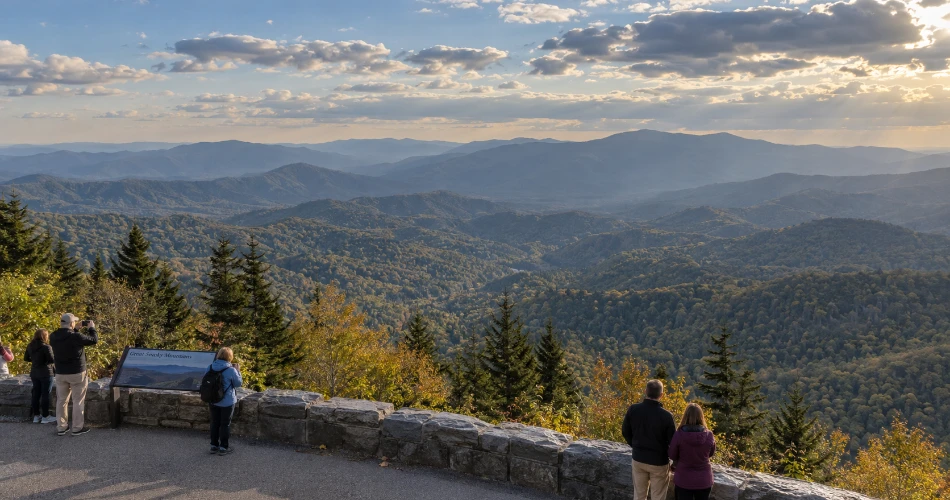
A trip to Gatlinburg feels incomplete if every mountain view comes from town. Newfound Gap Road carries travelers higher into the Great Smoky Mountains, where the forest, temperature, and horizon gradually change. Newfound Gap itself sits at 5,046 feet and is the lowest drivable gap through the national park. Because of that elevation, conditions can be considerably cooler than in Gatlinburg; rain in town can even become snow at the gap during colder weather.
The overlook is also one of the easiest high-country stops for visitors who are not planning a major hike. Several mountain layers are visible from the parking area when conditions cooperate, and the Appalachian Trail passes through the area.
Farther up the seasonal Kuwohi Road is Kuwohi, the mountain formerly known as Clingmans Dome. The high-elevation area includes a visitor contact station and the familiar observation tower, reached by a steep paved path. The tower provides panoramic views across the Smokies on clear days.
Visitors should check road conditions before leaving Gatlinburg because weather can affect high-elevation access. Parking is also limited at popular times. The park does not charge an entrance fee, but vehicles parked for more than 15 minutes generally need a physical parking tag; current rates are $5 daily, $15 weekly, or $40 annually.
Keep an Indoor Block for Ripley's Aquarium of the Smokies
Ripley's Aquarium of the Smokies is useful for more than filling a rainy afternoon. Its location in central Gatlinburg makes it easy to combine with the Parkway, but the exhibits deserve enough time to be seen without rushing from tank to tank.
Shark Lagoon is the signature section for many visitors. A moving glidepath passes beneath an underwater environment containing species that include sand tiger sharks, sandbar sharks, green sea turtles, sawfish, moray eels, and large schools of fish. Penguin Playhouse provides a completely different experience, with endangered African penguins moving between indoor and outdoor habitat areas and underwater viewing spaces.
The aquarium also schedules dive programs, animal feedings, and other presentations throughout the day, although the exact timetable changes and should be checked for the date of the visit.
Families often get the most from this stop by allowing children to linger at the viewing areas rather than trying to maintain a strict pace. Adults without children may find the aquarium equally useful during bad weather or as a quieter break between outdoor activities.
And there is something pleasantly strange about spending the morning in Appalachian forest and the afternoon walking beneath sharks. Gatlinburg has always been good at unlikely combinations.

Walk the Parkway Without Trying to Do Everything
Downtown Gatlinburg's Parkway can be noisy, crowded, bright, and surprisingly entertaining when approached without the expectation of visiting every attraction along it. The main road runs through the center of town, bringing shops, restaurants, observation attractions, arcades, and pedestrian traffic into a compact corridor. For a quieter alternative, Gatlinburg's river walk provides stretches where the sound of the Little Pigeon River replaces much of the Parkway traffic.
This is one of those parts of town where an itinerary benefits from becoming temporarily vague. Travelers can cross the pedestrian bridges, watch the river, browse a few stores, or stop when a view toward the mountains appears between buildings. The Parkway has a talent for turning a planned ten-minute walk into an hour, and that is not always a bad thing.
Morning provides a calmer experience, particularly for photography. Evening brings a completely different atmosphere as signs and attractions light up and pedestrians fill the sidewalks. Visitors staying for sunset at one of the mountaintop Gatlinburg sights can also walk the Parkway afterward without moving the car again.
The main mistake is allowing downtown to consume every available hour. Gatlinburg works because the busy streets and the Great Smoky Mountains sit so close together. A good visit gives both sides of town their share of the schedule.
Plan Around Weather, Parking, and Distance Rather Than a Checklist
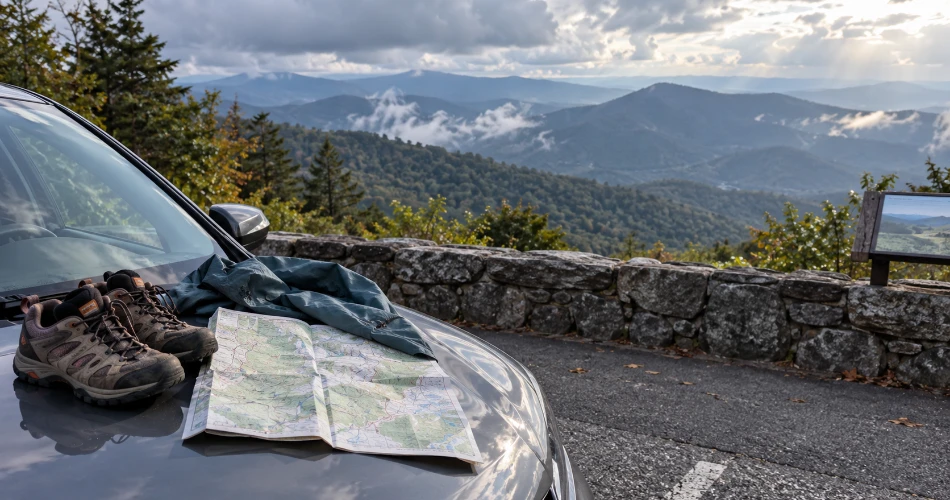
The best Gatlinburg sights are close enough to tempt travelers into overplanning. Downtown attractions may sit only a short walk apart, but a high-elevation drive, a slow forest road, or a mountaintop attraction can easily occupy several hours. Building a trip around geographic groups usually produces a more relaxed experience than bouncing repeatedly between town and the national park.
A few planning habits make a noticeable difference:
- Pair downtown stops such as Gatlinburg SkyPark, Anakeesta, the aquarium, and a Parkway walk instead of moving the car between each one.
- Combine Sugarlands with Newfound Gap when road and weather conditions are favorable.
- Give Roaring Fork Motor Nature Trail its own unhurried block rather than squeezing it between timed attractions.
- Purchase the Great Smoky Mountains parking tag before reaching trailheads or roads where no machine is available.
Season matters too. Spring brings flowing streams and fresh forest growth, summer brings long daylight, autumn brings extraordinary color along with the year's heaviest sightseeing pressure, and winter can provide clearer views while closing some high-elevation roads.
Ultimately, Gatlinburg is most rewarding when the itinerary leaves room for mountains to behave like mountains. Fog rolls in. Parking lots fill. A stream looks better than expected and delays the next stop. The places that stay in memory are rarely the ones rushed through simply because another attraction was waiting.
Next post A Walk Through the Most Interesting Parts of Gatlinburg
Previous Post What to See First When You Arrive in Gatlinburg
About Author