English

 Home
Home Hotels
  Car Rental
 Rewards
 Travel Guide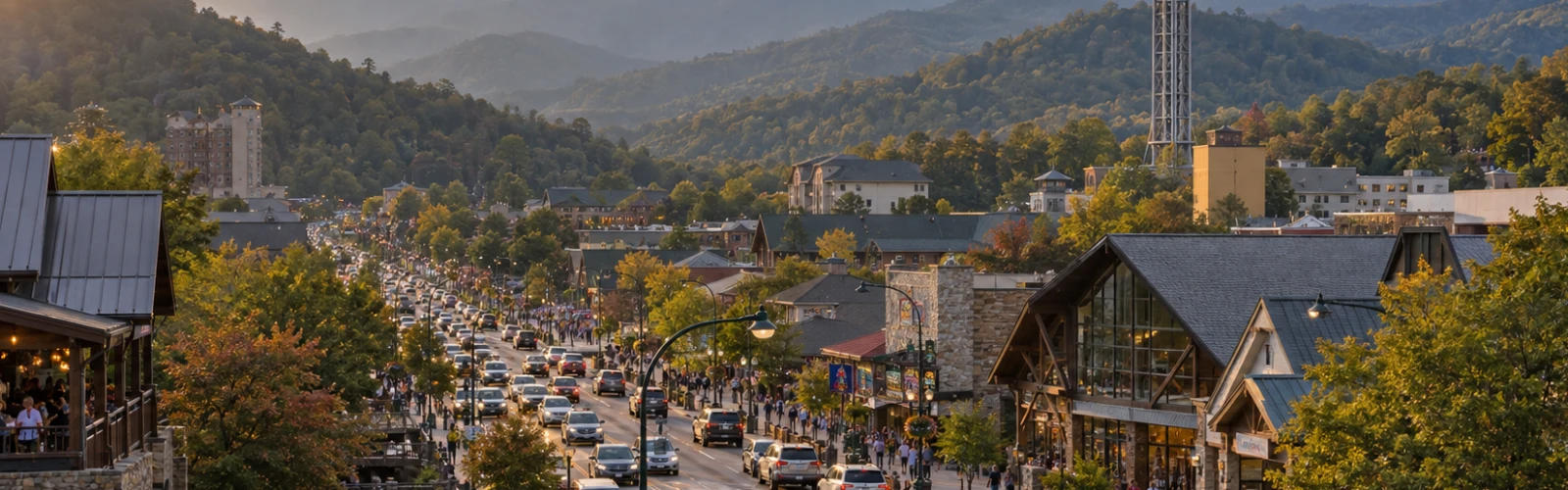
What to See First When You Arrive in Gatlinburg

Gatlinburg can feel surprisingly busy on a first arrival. One moment the road is threading through wooded Tennessee hills, and the next there are chairlifts overhead, neon storefronts, mountain attractions, pedestrians crossing the Parkway, and Great Smoky Mountains National Park waiting just beyond downtown. The easiest mistake is trying to see everything immediately. A better first day is about getting oriented. Some of the best Gatlinburg attractions are useful precisely because they show how the town fits into the surrounding mountains. A walk along the Gatlinburg Parkway reveals the compact downtown layout, while an elevated viewpoint helps put the ridgelines into perspective. Just a couple of miles south, Sugarlands Visitor Center introduces the national park that gives Gatlinburg much of its character. From there, travelers can choose between a scenic mountain drive, a short nature stop, or a return downtown when the lights come on. For a Gatlinburg first-time visitor, these are the places that make the rest of the trip easier to understand.

Start With a Walk Along the Gatlinburg Parkway
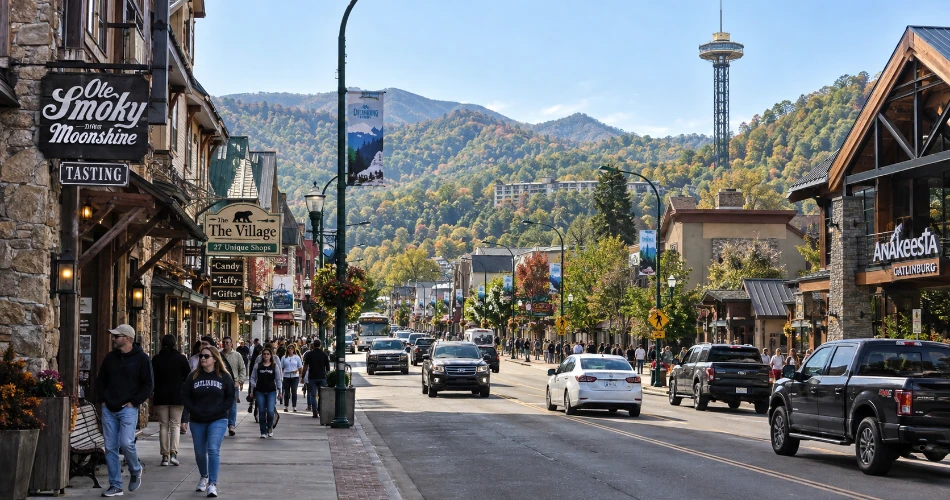
The Gatlinburg Parkway is the most useful place to begin because it quickly shows how compact downtown Gatlinburg really is. Instead of immediately driving from attraction to attraction, first-time visitors can park once and walk a section of the main street. Many restaurants, shops, observation attractions, entertainment venues, and access points to elevated mountain experiences sit within a relatively small central area, making the Parkway one of the easiest introductions to Gatlinburg sightseeing. The town also operates a free trolley system year-round, so visitors do not necessarily need to return to their car every time they want to move farther along downtown.
The best first walk is not about ticking off every storefront. It is more useful to notice where major landmarks sit in relation to one another and where side streets lead away from the busiest traffic.
A few things worth noticing immediately include:
- the Gatlinburg Space Needle rising above the downtown buildings;
- chairlifts and gondolas climbing the surrounding slopes;
- River Road running roughly parallel to part of the Parkway;
- the direction of Great Smoky Mountains National Park to the south.
An hour here gives newcomers a mental map they will use for the rest of the trip.
Get the Big Picture From the Gatlinburg Space Needle
Seeing Gatlinburg from street level is useful; seeing it from above makes the layout click. The Gatlinburg Space Needle stands 407 feet tall and has a 360-degree observation deck reached by glass elevators. From the top, visitors can look down onto downtown Gatlinburg while seeing the much larger mountain landscape enclosing the town.
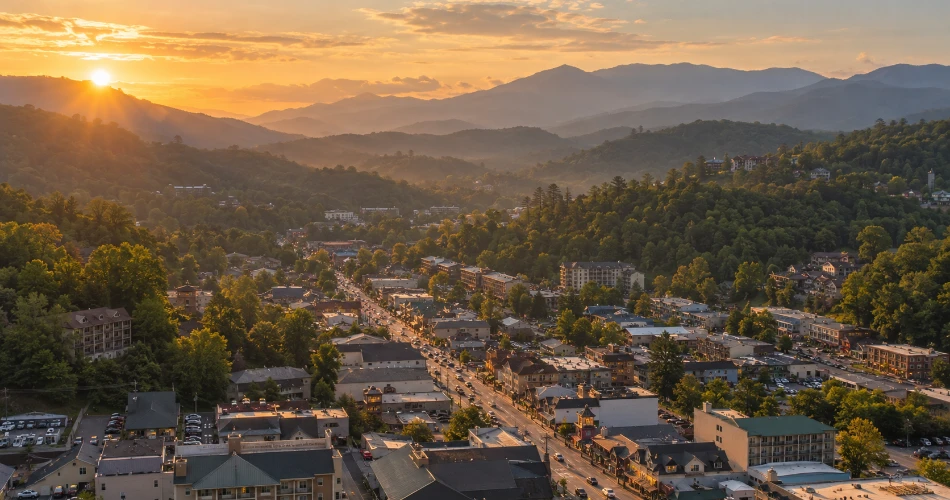
For someone who has only recently arrived, that perspective is more valuable than it might sound. The narrow urban strip suddenly looks tiny beside the surrounding ridges, and the relationship between the town and the Great Smoky Mountains becomes obvious. On a clear day, distant ridges appear in overlapping layers; when moisture hangs in the atmosphere, the famous bluish haze gives the scene a very different character.
Late afternoon works especially well because there is usually enough daylight to identify roads and ridges while the changing light begins to soften the mountains. Returning after sunset produces a completely different view as the Parkway lights up below. It is one of those Gatlinburg attractions that works particularly well near the beginning of a trip because it helps visitors understand where they actually are rather than simply giving them another activity to complete.
Walk Up to Gatlinburg SkyPark for a Higher Mountain View
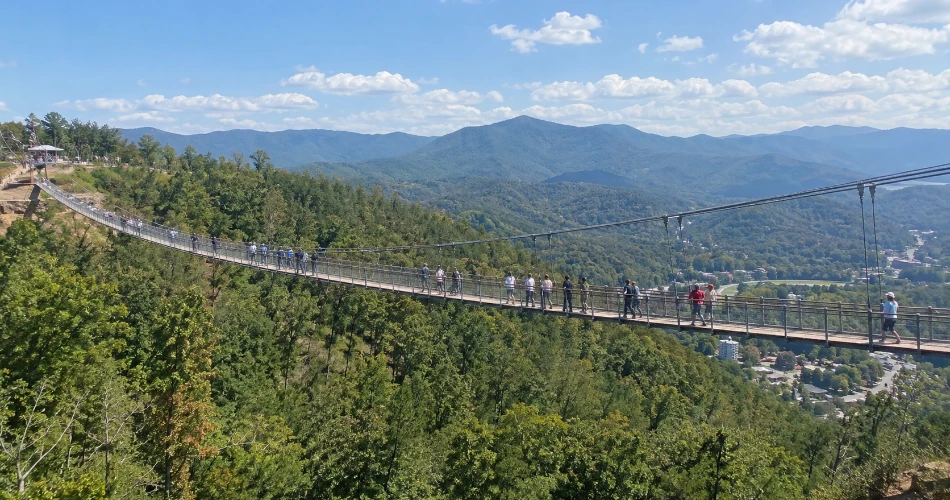
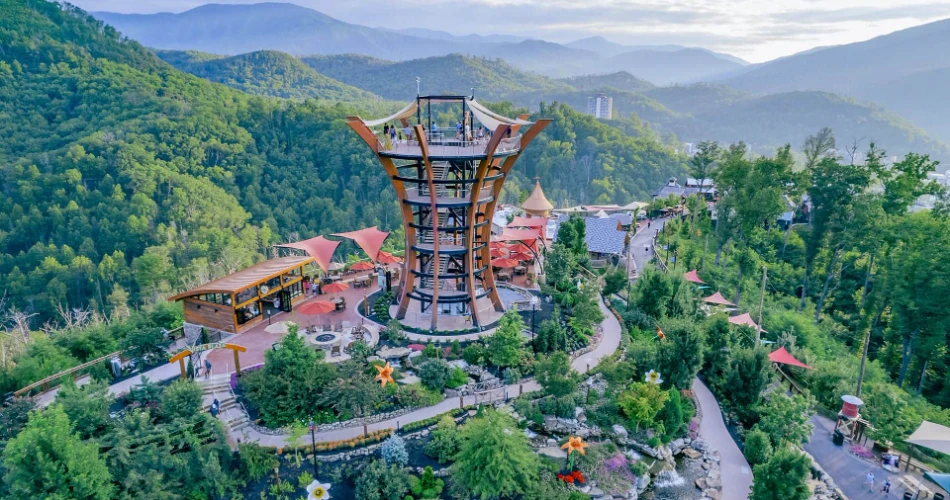
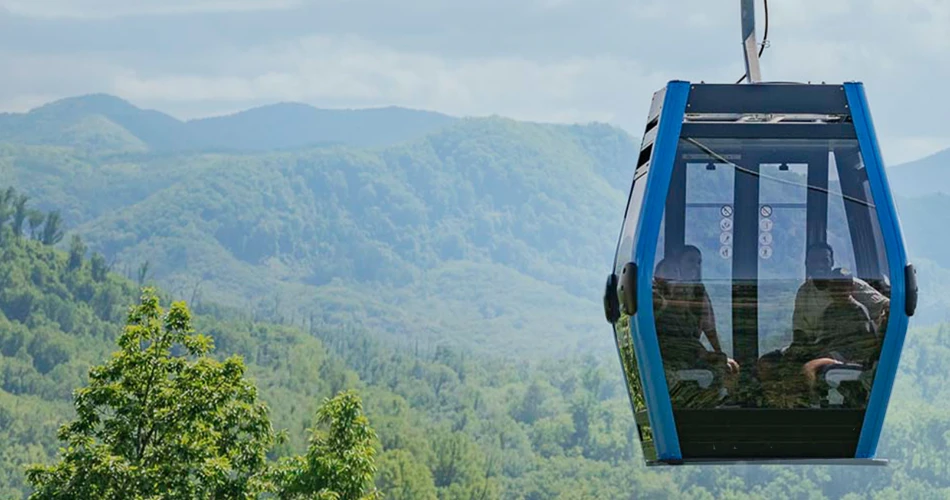
Gatlinburg SkyPark offers another elevated introduction, but the experience feels different from a traditional observation tower. Visitors ride the open-air SkyLift from downtown to the mountaintop, where the SkyBridge crosses nearly 700 feet over a valley. The attraction describes it as the longest pedestrian cable bridge in North America, and its position roughly 500 feet above downtown gives visitors broad views toward Great Smoky Mountains National Park.
The bridge gets most of the attention, especially the transparent sections near its middle, but travelers who are uncomfortable with heights do not need to rush across simply because everyone else seems to be doing it. Spending time at the viewing areas can be just as useful on a first visit. From up here, the buildings of downtown Gatlinburg appear tucked into a narrow valley rather than spread across a broad city grid.
The mountain setting also changes noticeably through the seasons. Summer brings deep green slopes, fall replaces them with patches of red, gold, and orange, and winter often exposes more of the ridge structure once the leaves have dropped. Anyone building a list of things to do in Gatlinburg should consider one elevated viewpoint early in the trip; SkyPark is especially suitable when that viewpoint is meant to feel like an activity as well as a photo stop.
Make Sugarlands Visitor Center the First National Park Stop
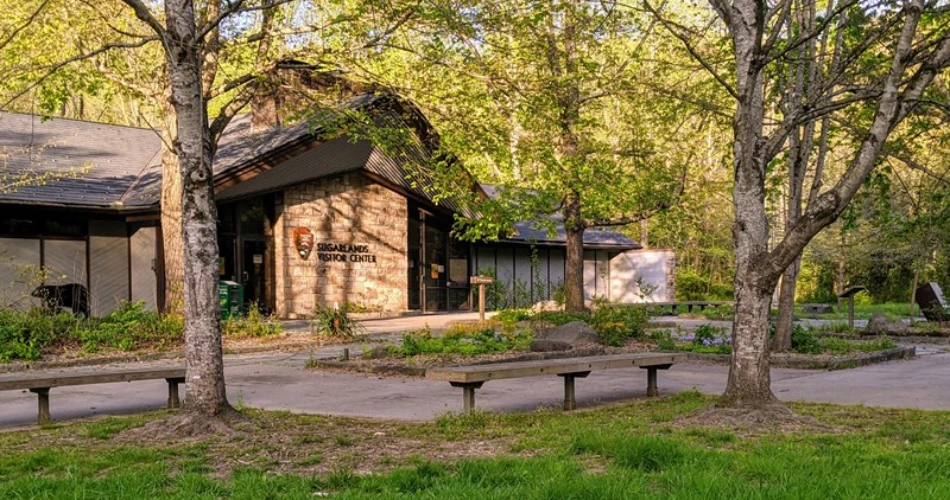
Just two miles south of Gatlinburg on Newfound Gap Road, Sugarlands Visitor Center is one of the most sensible first stops inside Great Smoky Mountains National Park. The National Park Service describes Sugarlands as the northern gateway to the Smokies, and the visitor center provides natural-history exhibits, maps, staff assistance, restrooms, seasonal ranger programs, and access to the park's Backcountry Office.
This is where a casual mountain vacation can become a much better-planned one. Rather than relying on a list saved weeks earlier, visitors can check current road, trail, and weather conditions before heading deeper into the park. That matters because conditions at higher elevations can differ considerably from downtown Gatlinburg, and secondary roads may close seasonally or temporarily.
There is also an important practical detail for anyone driving into the Great Smoky Mountains. The park does not charge an entrance fee, but a parking tag is required when a vehicle is parked inside park boundaries for more than 15 minutes. Current rates are $5 daily, $15 weekly, or $40 annually. For a first visit, Sugarlands is not merely an information desk. It is the point where the busy resort town gives way to forest, creeks, trails, and the landscape travelers usually came to Gatlinburg hoping to see.
Take Newfound Gap Road Into the Mountains
After stopping at Sugarlands Visitor Center, Newfound Gap Road is the most natural next move. Also designated U.S. 441, the road crosses Great Smoky Mountains National Park between Gatlinburg, Tennessee, and Cherokee, North Carolina. It climbs from lower-elevation hardwood forest toward cooler high-elevation terrain and provides access to several overlooks, trailheads, Newfound Gap, and the road leading toward Kuwohi.
Travelers do not need to drive the entire route on their first afternoon. In fact, stopping at a few legitimate overlooks usually creates a better experience than racing from downtown to the state line and back. Elevation increases quickly, which means the vegetation and temperature can change noticeably along the way. Even when downtown Gatlinburg feels warm, exposed viewpoints farther up the mountain can feel much cooler.
Newfound Gap itself is one of the most recognizable Smoky Mountains attractions because the Tennessee–North Carolina state line crosses the area and the Appalachian Trail passes through nearby. The view can be spectacular when the sky is clear, but clouds and fog are part of the mountain landscape too.
The road is generally open year-round, weather permitting, although snow, ice, fallen trees, or hazardous conditions can cause temporary closures. Checking the National Park Service road status before leaving Gatlinburg is far more useful than assuming the weather downtown tells the whole story.
Go Higher to Kuwohi When the Weather Cooperates
When skies are reasonably clear and Kuwohi Road is open, Kuwohi makes a memorable early introduction to the scale of the Smokies. Formerly known as Clingmans Dome, Kuwohi is the highest peak in Great Smoky Mountains National Park. The access road branches from Newfound Gap Road and runs approximately seven miles to the visitor area.
The familiar observation tower sits above the parking area, reached by a paved but notably steep half-mile trail. The distance sounds easy on paper; the climb usually feels longer because of the gradient and high elevation. Visitors who move steadily rather than treating it like a race tend to enjoy it more. Weather can also change fast at this elevation, so a light extra layer is useful even when Gatlinburg feels comfortable.
Kuwohi Road is seasonal. For the 2026 season, the National Park Service lists it as open from April 1 through November 29, subject to temporary closures for snow, ice, or other dangerous conditions. The Kuwohi Visitor Center itself also closes during winter. This is one place where a clear forecast should influence the schedule. If thick cloud completely covers the high peaks, saving Kuwohi for another morning may produce a much more rewarding view.
Save Time for Ripley’s Aquarium of the Smokies
Not every worthwhile first stop needs to involve a mountain overlook. Ripley’s Aquarium of the Smokies sits at 88 River Road near the heart of downtown, making it particularly useful when rain, summer heat, or poor mountain visibility changes the day's plans. The aquarium reports more than 10,000 animals representing over 350 species.
Its Shark Lagoon is the section many visitors remember most clearly. A moving glidepath carries guests through an underwater environment where sharks, sawfish, green sea turtles, moray eels, tarpon, and other marine species can pass overhead or alongside the tunnel. Because the experience is indoors, it also works well as a flexible part of a Gatlinburg first-time visitor itinerary rather than something that has to be scheduled around perfect weather.
Another practical advantage is location. The city's Mass Transit Center is located at the aquarium, and Gatlinburg trolleys connect through this central area. That makes it easy to finish an aquarium visit and continue through downtown without moving the car.
The contrast is part of the fun: visitors can spend the morning overlooking Appalachian ridges and, a few hours later, walk beneath sharks. Gatlinburg has always mixed natural scenery with unapologetically tourist-friendly attractions, and the aquarium is one of the clearest examples.

Drive Roaring Fork When There Is Time for a Slower Detour
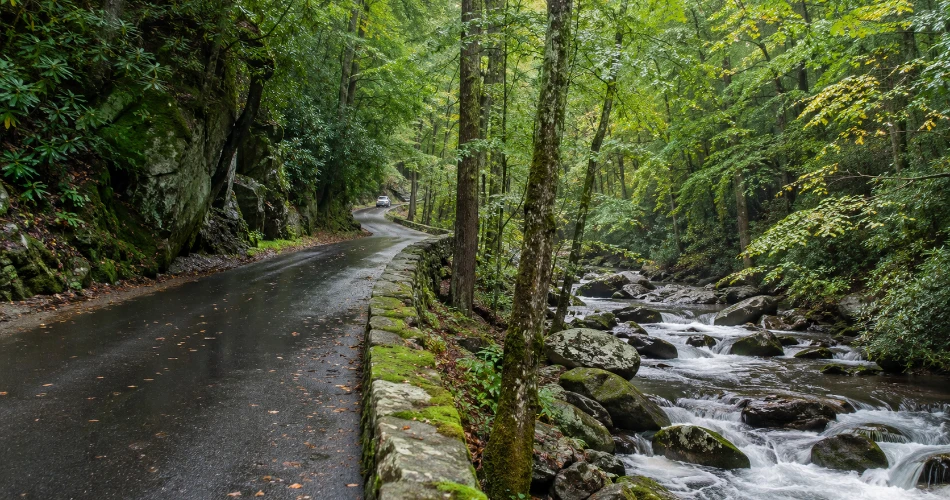
For travelers who still have daylight after becoming familiar with downtown, Roaring Fork Motor Nature Trail offers a much quieter side of Gatlinburg. The route begins from the Historic Nature Trail area and enters Great Smoky Mountains National Park near Cherokee Orchard. The National Park Service describes it as a one-way scenic road through dense forest, with historic sites, trail access, streams, and roadside scenery along the way.
This is not a drive to rush. The road is narrow and steep in places, and the point is to notice the forest rather than cover distance quickly. Near the end, Place of a Thousand Drips forms a delicate cascade over the rock face beside the roadway, especially noticeable after wet weather. The route also provides access to the Trillium Gap Trail toward Grotto Falls, although parking around popular trailheads can be difficult.
Roaring Fork is seasonal rather than year-round. The National Park Service's 2026 schedule lists the Motor Nature Trail as open April 17 through November 29, conditions permitting. Buses, motorhomes, trailers, and other oversized vehicles are prohibited.
For a first day, the drive works best when the schedule is deliberately loose. It gives visitors something the Parkway cannot: a close look at the wet, shaded forest that gives the Smokies much of their atmosphere.
Return Downtown After Dark Before Calling It a Day
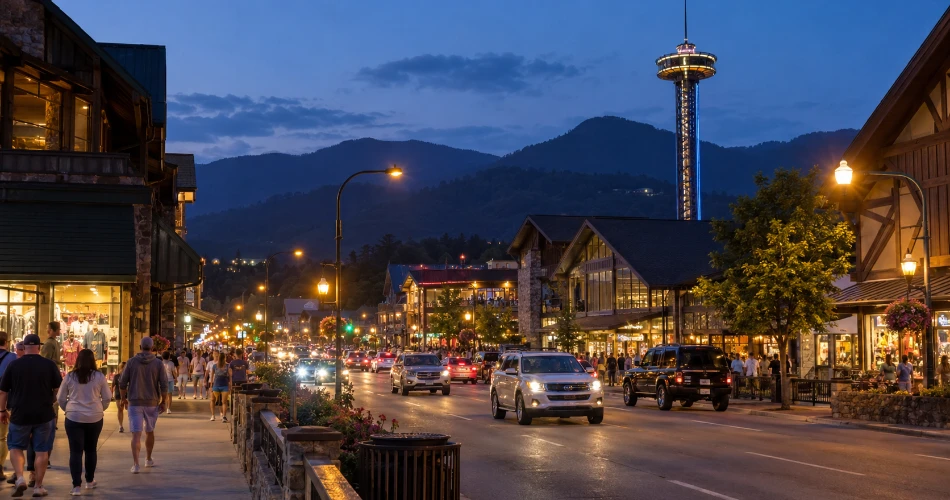
Gatlinburg is worth seeing twice on the first day: once before sunset and again after dark. The physical layout does not change, but the atmosphere does. Chairlifts continue climbing the slopes, signs and storefronts illuminate the Parkway, the Space Needle stands brightly against the dark ridges, and the mountains gradually disappear into silhouettes behind downtown.
Visitors who parked earlier may find it easier to stay on foot or use the free trolley rather than joining evening traffic for a series of short drives. Gatlinburg trolleys operate daily throughout the year, although hours vary seasonally and by route. For those driving, the city operates several public parking facilities, including the Aquarium Garage and McMahan/Parkway Garage; current city information lists both at $15 per day.
This is also the right point to stop trying to “complete” Gatlinburg. There will always be another attraction, shop, scenic chairlift, dessert counter, or mountain road waiting nearby. A leisurely evening walk makes more sense than squeezing in three more tickets before bedtime.
By now, a newcomer should recognize the major landmarks, understand which direction the national park lies, and know which parts of downtown are easy to reach on foot. That familiarity pays off for the rest of the vacation.
Let the First Day Set Up the Rest of the Gatlinburg Trip
A good first day in Gatlinburg should leave a few things unfinished. That is part of the point. Once travelers have walked the Gatlinburg Parkway, seen downtown from above, stopped at Sugarlands Visitor Center, and taken at least one drive into the Great Smoky Mountains, the destination becomes much easier to navigate. Longer hikes, additional scenic roads, shopping, evening entertainment, and other Gatlinburg attractions can then be fitted into the following days with far less guesswork.
Weather should help decide the order. A clear morning belongs to Newfound Gap or Kuwohi. Low clouds may make downtown attractions or the aquarium a better choice. A wet afternoon can make the forest around Roaring Fork particularly atmospheric once conditions are safe. Above all, visitors should resist treating Gatlinburg and the national park as separate vacations. The contrast between the lively Parkway and the protected mountain landscape just beyond town is precisely what makes this corner of Tennessee unusual.
For first-time visitors, the best plan is simple: get oriented downtown, gain some elevation, enter the national park, and leave enough space in the schedule to follow whatever looks interesting along the way. That approach turns the first few hours into more than sightseeing—it gives the rest of the Gatlinburg trip a sense of direction.
Next post Gatlinburg Sights Worth Making Time For
Previous Post Beautiful Places to Explore in and Around Gatlinburg
About Author